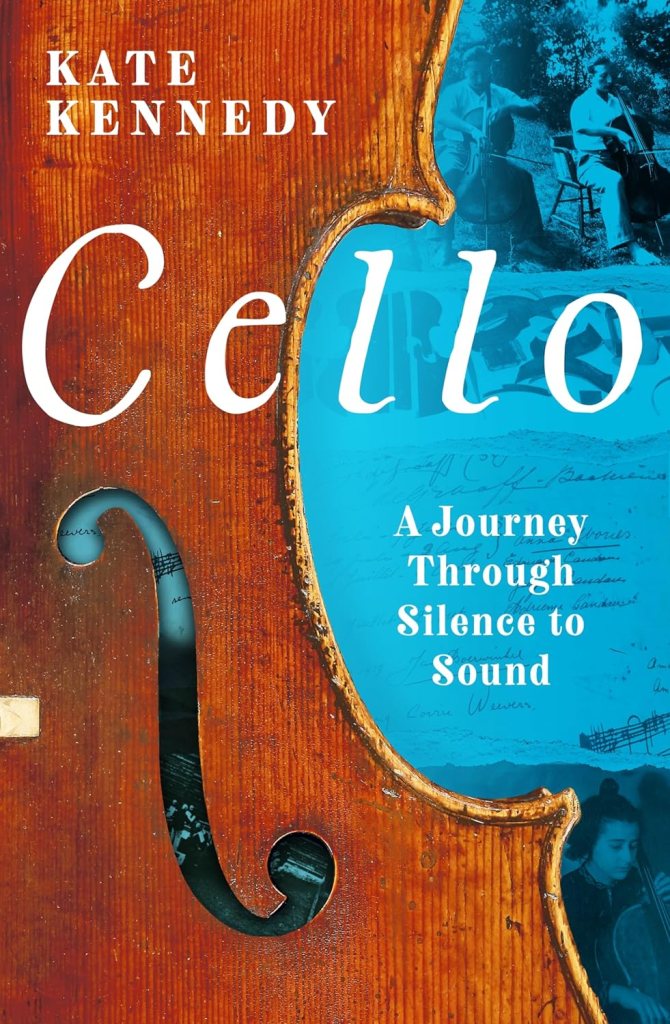
Cello: A Journey Through Silence to Sound (Bloomsbury, 15 August 2024)
Shortlisted for the RPS Storytelling Award 2025
‘Just as a cello’s voice is divided across four strings, each with its own colour and character,
this is a journey in four parts, in search of four players and their instruments…’
In Cello, Kate Kennedy weaves together the lives of four remarkable cellists who suffered
various forms of persecution, injury and misfortune. The Hungarian Jewish cellist and
composer Pál Hermann managed to keep one step ahead of the Gestapo for much of the
Second World War but was eventually captured and murdered. Lise Cristiani, the first female
professional cello soloist, undertook an epic – and ultimately fatal – concert tour of Siberia in the 1850s, taking with her one of the world’s greatest Stradivari cellos. Anita Lasker-Wallfisch was incarcerated in both Auschwitz and Bergen-Belsen camps, only surviving because she was the cellist in the Auschwitz-Birkenau women’s orchestra. Amedeo Baldovino of the Trieste Piano Trio was forced to jump from a burning ship with his ‘Mara’ Stradivari, losing the cello, and nearly losing his own life when the boat was shipwrecked near Buenos Aires.
Counterpointing the themes raised by these extraordinary stories are a sequence of
interludes that draw together the author’s reflections on the nature and history of the cello,
and her many interviews and encounters with contemporary cellists. Kate Kennedy’s own
relationship with the cello is a complicated one. As a teenager, she suffered an injury to her arm that imposed severe limitations on her career as a performer on the instrument that was her first love. She realised that, in order to start to understand what the cello meant to her, she needed to find out what the cello – and, crucially, the absence of the cello – had meant to other cellists, past and present.
Part quest narrative, part detective story, part philosophical meditation, this is an eloquent
and multitextured homage to the cello, and a moving and compelling recreation of the lives
of four creative artists and their relationship with this most human and expressive of
instruments.
Listen here to five excerpts from the book adapted for BBC Radio 3.
Reviews
“This is a beautiful, richly fascinating book – a love song to the cello which, as if a character, lives within the lives of those musicians who play it.”—Sir Stephen Hough
“This wonderful book is a love-letter to cellos and cellists, a gripping quest across Europe for lost and sometimes miraculously re-found instruments, a startling plunge into the dark histories of our times, a meditation and improvisation on music and musicians, and a moving personal story of a cellist who has rediscovered her own gift for playing and with it the central meaning of her life.”—Dame Hermione Lee, University of Oxford
“Kate Kennedy has followed her cello heart, and it has led her on a fascinating and unusual path. An excellently researched, thoroughly absorbing account of a personal voyage of musical discovery.”—Steven Isserlis CBE
“Kate Kennedy’s quest across seas and continents, following the lives of four great cellists, is a rare musical adventure. Brimming with life, comic, thoughtful, and at times heartbreaking, Cello explores the bond between players and their instruments and its enduring power.”—Jenny Uglow OBE
“What a wonderful book Cello is — and how impossible to summarise in just a few words! A wonderfully evocative journey of exploration and contemplation in the company of four remarkable cellists and their equally remarkable instruments.”—Robin Lustig, former BBC broadcaster
“Kate Kennedy’s fascinating and deeply moving book about the cello weaves a lifetime’s passion for the instrument as a performer with her skills as a historian. This absorbing exploration of remarkable instruments and their players through death camps, shipwrecks, and on into the cellos of the future is an embodiment of the deep companionship between musician and instrument. I was fascinated by insights which only a professional cellist could know and by entirely unexpected aspects of the instrument’s physicality. Above all, Kennedy’s book is a deeply humane tribute to the partnership between composer, musician and instrument, ‘the soul of music’ and is a huge achievement.”—Gwyneth Lewis MBE
“Impeccably researched, gracefully written, and full of insight, this book will resonate with musicians and music lovers.”—Booklist
“Kate Kennedy takes a bird’s-eye view of four lives and five centuries as she turns her own instrument, the cello, into a prism. Part history, biography and auto-biography, with digressions into anthropology, acoustics and aesthetics and an intriguing cast of characters, Cello sings richly.”—The Spectator
“It is the cello’s capacity to live materially and biographically that Kate Kennedy explores in this strikingly original book. She organizes her account around four European cellists in the 19th and 20th centuries whose difficult and dangerous lives extended far beyond the good manners of the concert hall.”—The Times (London)
 Dr Kate Kennedy